Interactive history · Private beta
Step into history.
Understand how it was decided.
You are inside a real moment of the past, with only what people knew then. Decide, see where it leads, and compare your world with what actually happened.
Or open the demo in Telegram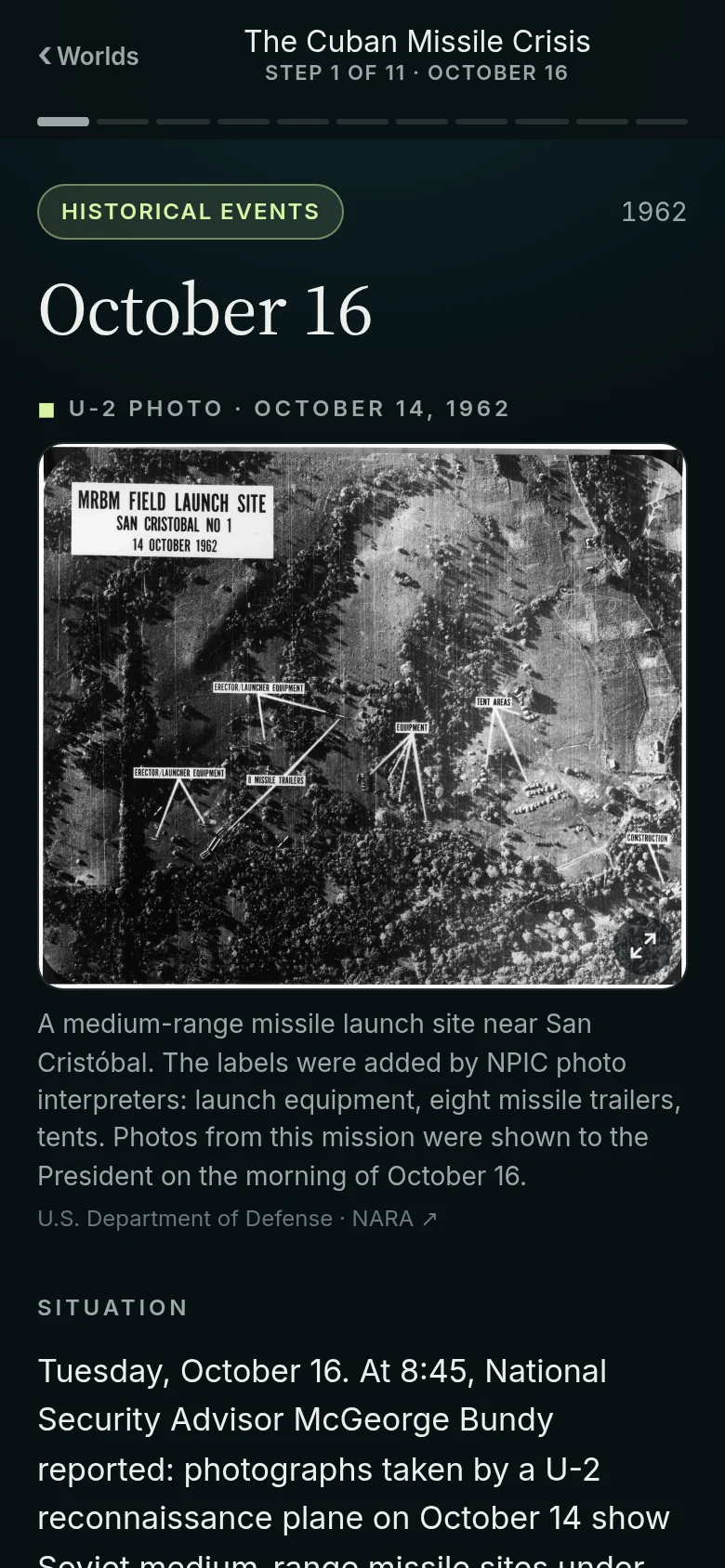
- 4worlds, four ways to play
- 13days of the Cuban crisis, 11 decisions
- 11endings — and one that really happened
- 0invented photos or quotes
One step
Evidence. Decision. What really happened.
-
01
Situation
Only what was on the desk that morning: a U-2 photo, a letter from Moscow, the latest estimate. Nothing from tomorrow's newspapers.
-
02
Decision
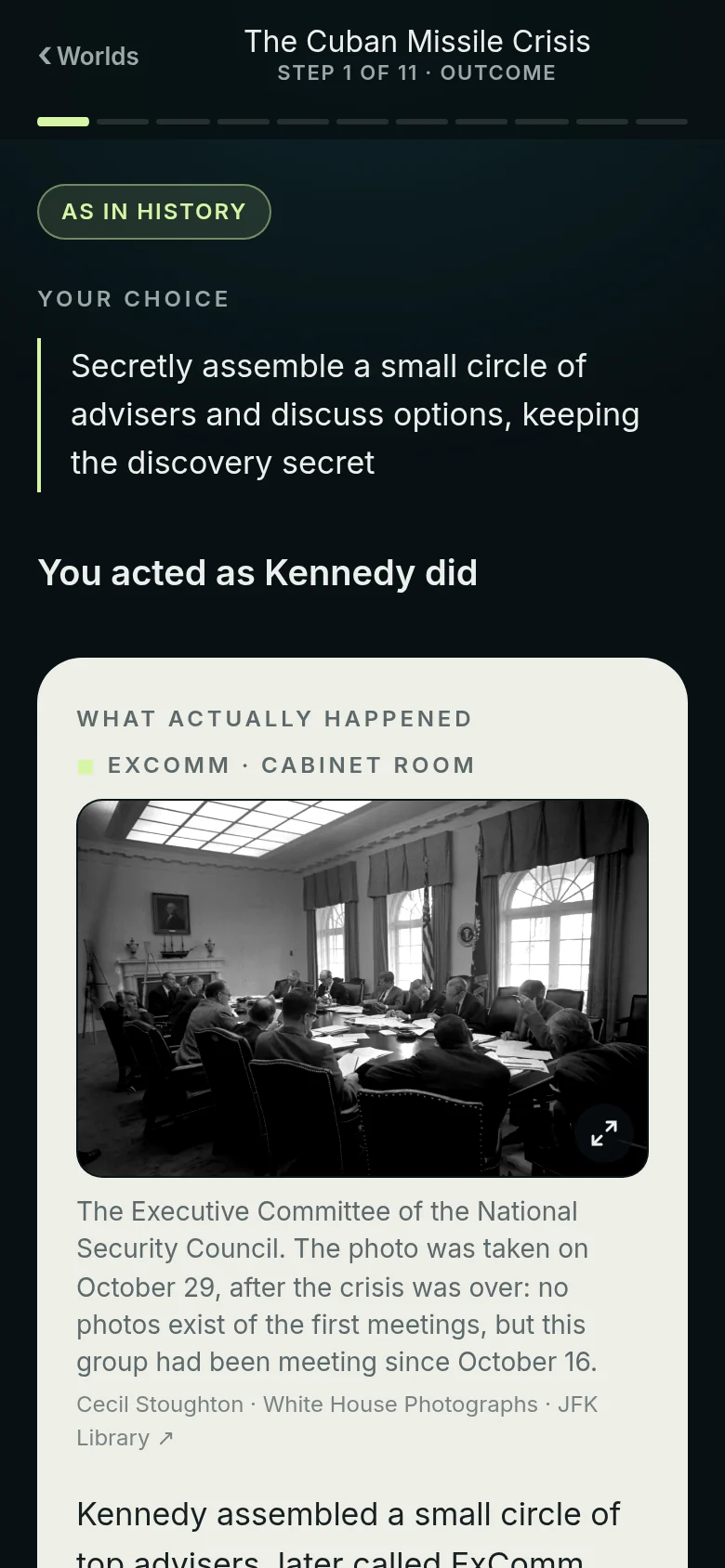
Four options and no risk-free one. The historical choice is not marked.
-
03
Outcome
Did you act as Kennedy did? What actually happened, with the photograph and its source.
-
04
The world moves on
Repeat the real decision and history goes on as it did. Deviate, and the world diverges as far as that choice plausibly matters.
Four worlds are open
Four worlds. Four ways to play.
Each world is a different kind of simulation: a crisis that branches, a reading of other capitals, a ledger on the road, an investigation on a map.
The Cuban Missile Crisis
You are President Kennedy
Thirteen days in October. Every decision moves the world off its historical line, as far as it plausibly can.
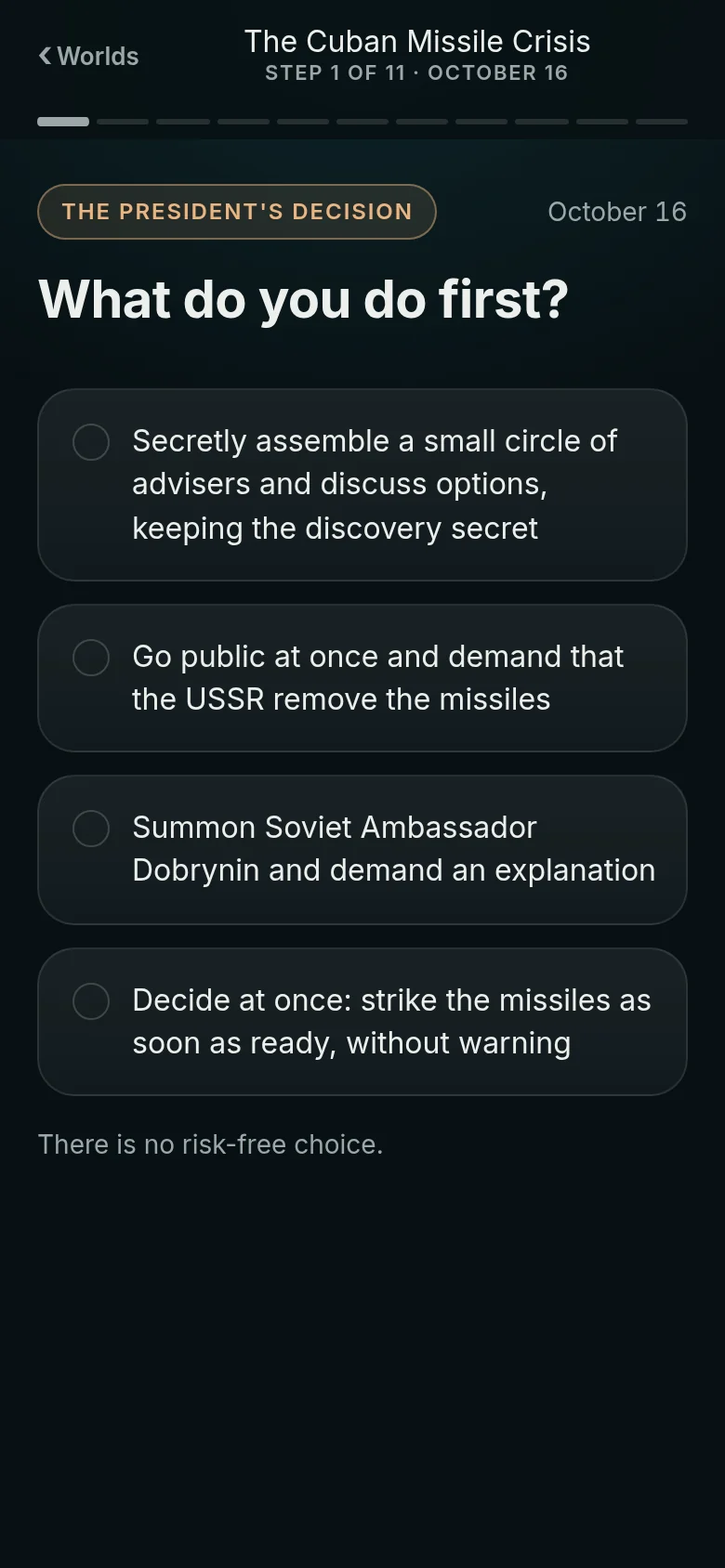
- 01October 16The U-2 photos are on the desk. What do you do first?
- 02October 18Gromyko insists the aid is defensive. What do you tell him?
- 03October 20Air strike or blockade?
- 04October 22Do you prepare an invasion openly?
11 decisions, 56 situations, 134 paths, 11 endings. One of them really happened.
- historical line
- adjusted, returns to history
- replaced: a path nobody took
- ending: war, deal or stalemate
The July Crisis
You are a researcher of causes
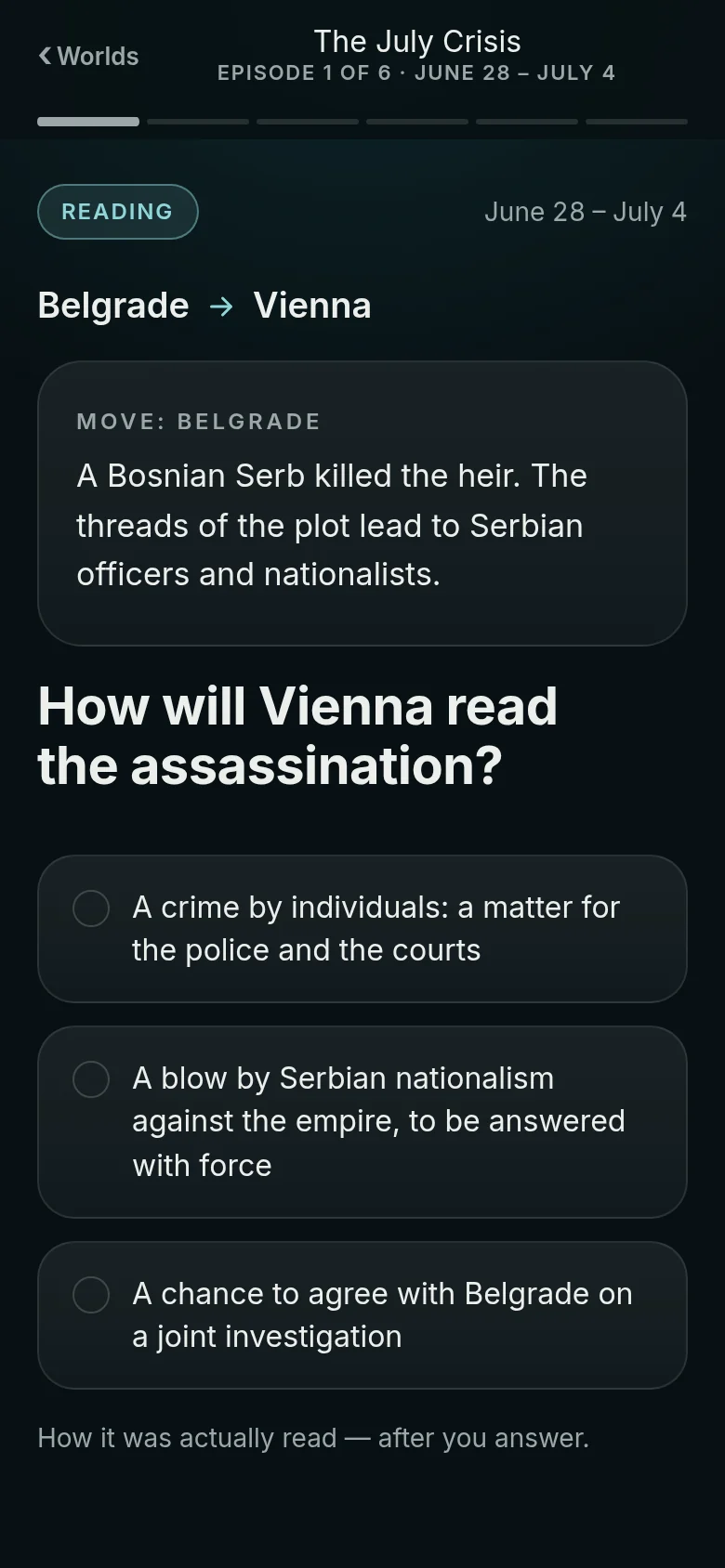
A month from Sarajevo to war. One capital makes a move; you predict how another will understand it, then sit where the decision was made.
- 01June 28 – July 4The shots in Sarajevo. How will Vienna read them?
- 02July 5–22In Bethmann Hollweg's seat in Berlin. What do you tell Vienna?
- 03July 23–27The ultimatum. Pašić has hours to reply.
- 04July 28–29War on Serbia. How does the Kaiser read Serbia's reply?
Real history only: your reading is compared with what was intended and what was actually read.
The Merchant of Chang'an
You are Li Wen, cloth merchant
Buy goods on credit, carry them to Luoyang and sell them so that the family lives to see winter. Chance decides the outcome, but the odds are visible in advance.
- 01Day 1Forty strings of coin, two bales of cloth, no debts. Whom do you ask about prices?
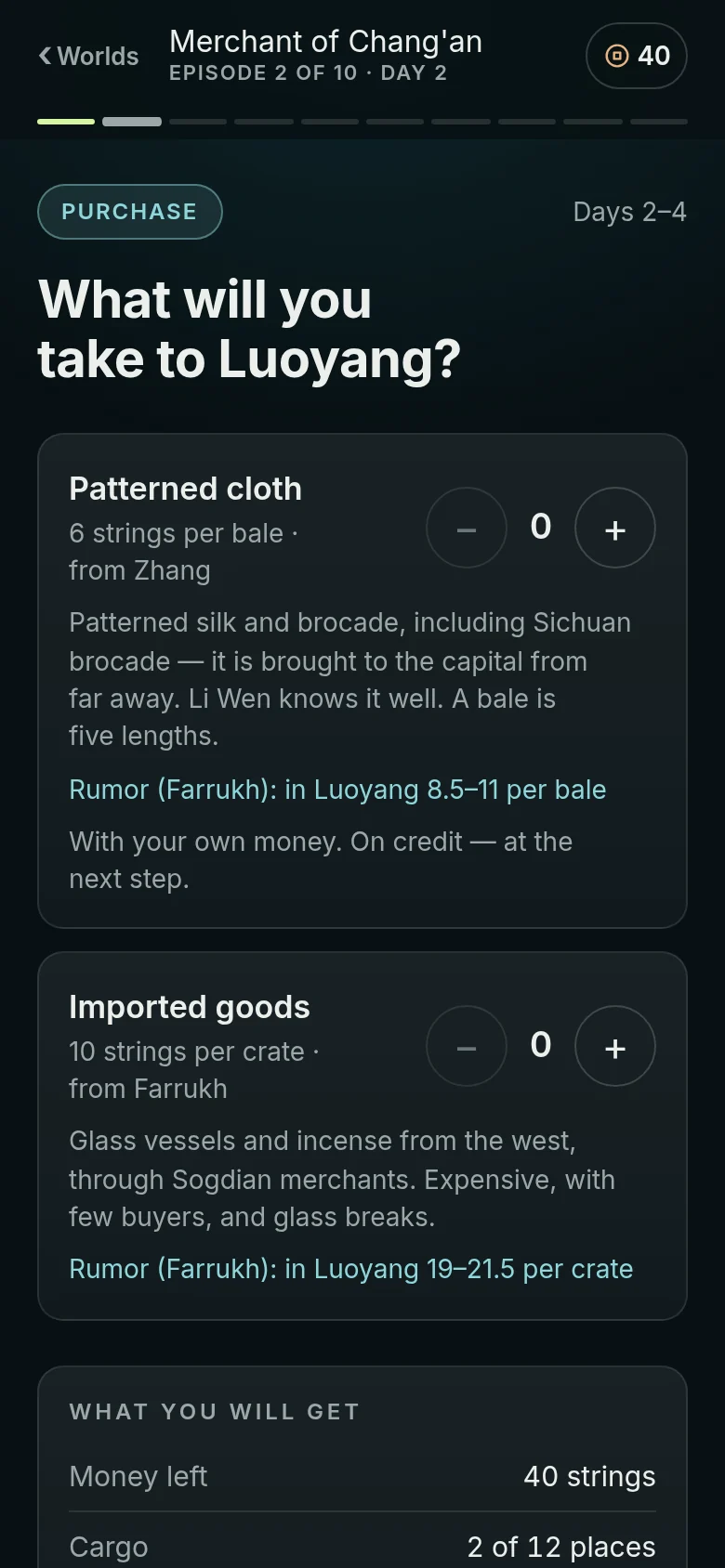
- 02Days 2–4What do you take to Luoyang? Cloth on credit: repay plus a twelfth by day 58.
- 03The roadFrom one overnight stop to the next. People tell you the risk; no one knows the outcome.
- 04LuoyangHaggling, one round a day. The buyer may walk away.
A fictional merchant in a documented economy: prices, interest and roads of the Tang dynasty.
Cholera in Soho
You are Dr. Snow's assistant
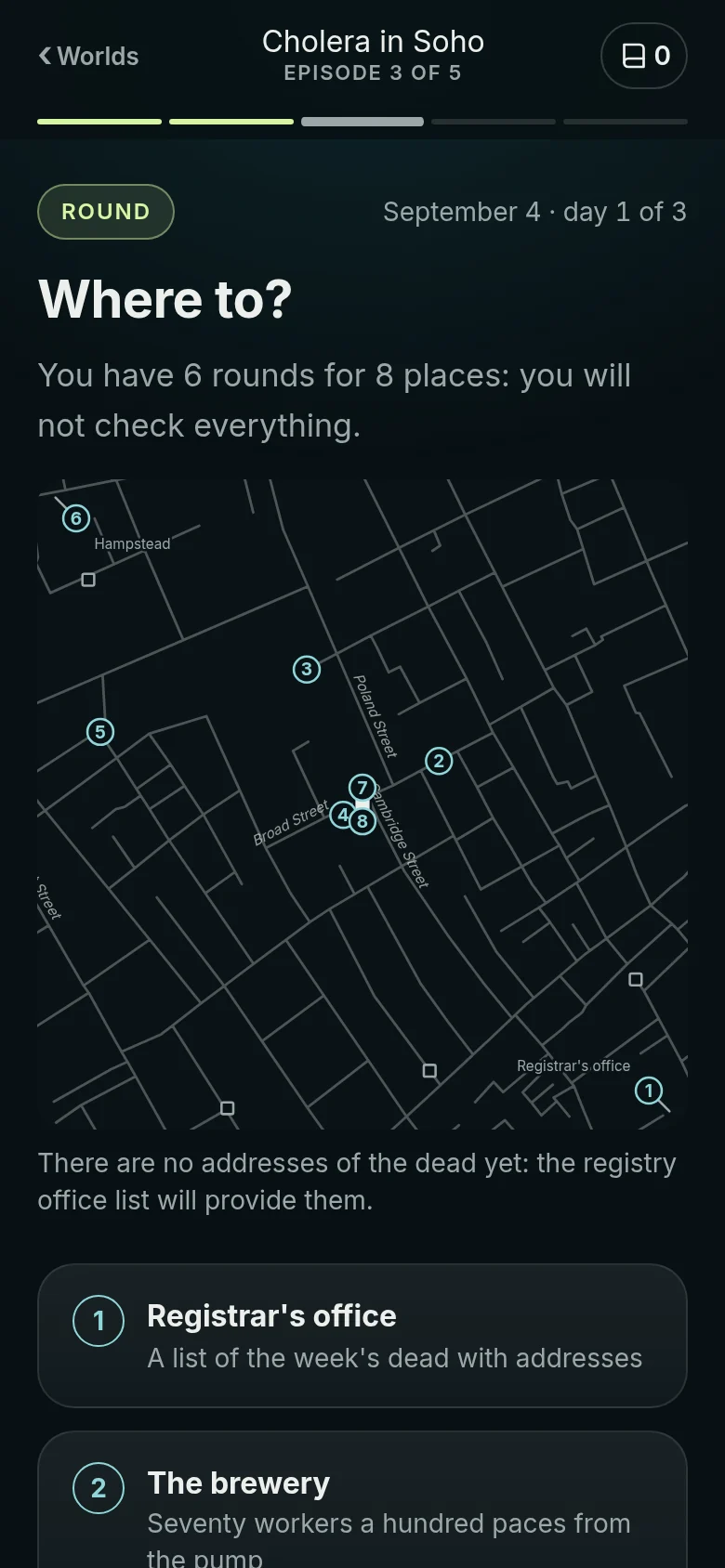
Ten days of epidemic on Broad Street. Say what you expect before you look, choose where to go, and work out what is killing people: water, air or poverty.
- 01August 31 – September 2Catastrophe. Why several dead in one house and none next door?
- 02September 3The pump. If the water is to blame, what will Snow see in the sample?
- 03September 4–6Rounds. Six rounds for eight places: where to?
- 04September 7The Board of Guardians. Which three findings do you put on the table?
The finale compares your notebook with Snow's conclusions.
Why
History is not a list of dates. It is people deciding with incomplete information, and living with the consequences.
Textbooks tell you how it ended. Worlds lets you stand where it had not ended yet.
Every fact has a source
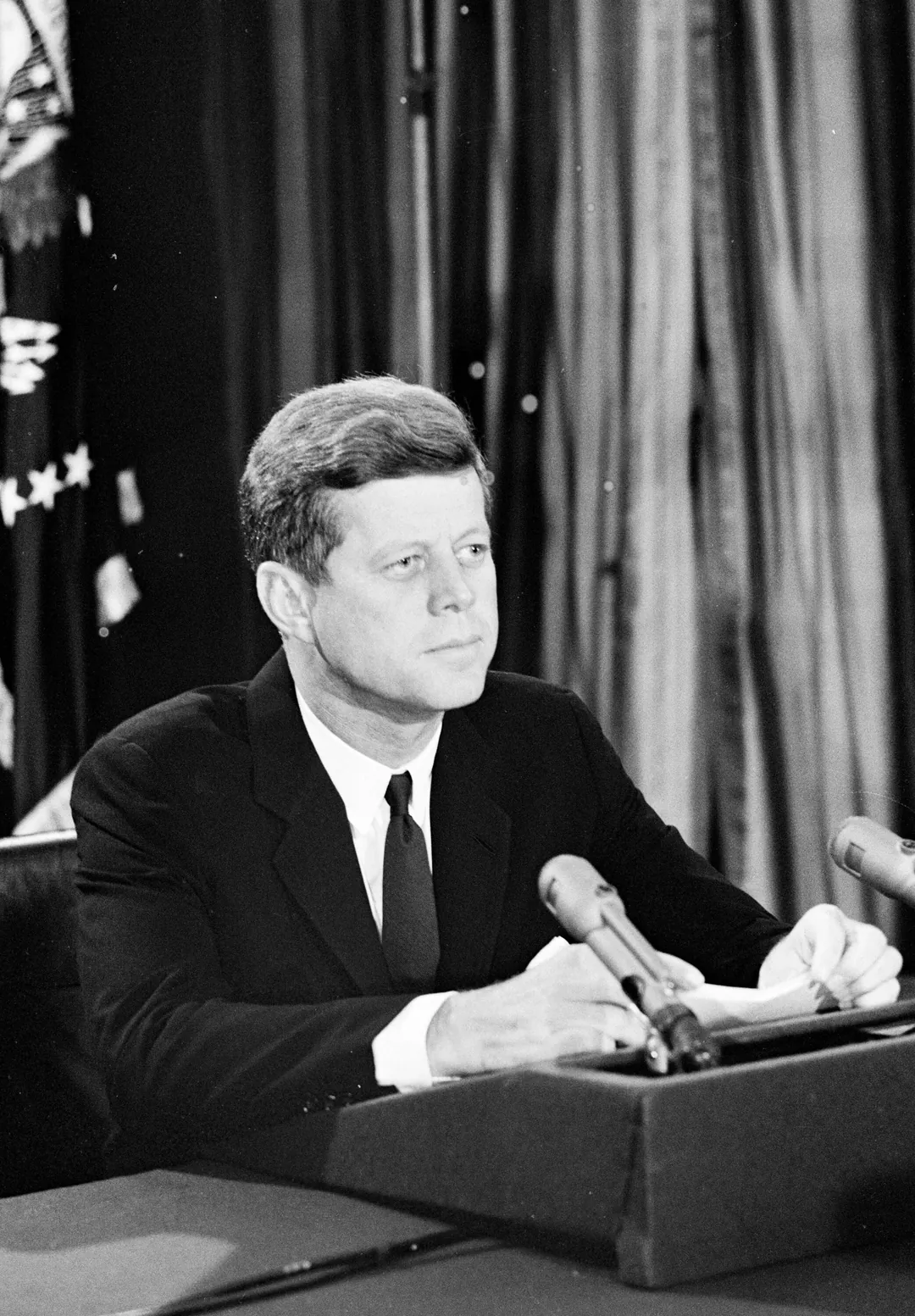
Photographs from the U.S. National Archives and the JFK Library, letters from the Library of Congress, maps drawn from declassified estimates. Every image carries its date and credit. Where no photo exists, we say so instead of inventing one.
Demo
See it working
Demo video
A two-minute walk through one step of the crisis. Coming with the beta.
Try it now
The prototype runs in Telegram
Open the bot, pick a world and play. Four worlds, English and Russian, no sign-up.
Open @worlds_dev_botComing next
Turn your question into a world
Soon Worlds will build a world from a question: sources, a timeline and the moments of decision.
- What if Napoleon had won at Waterloo?
- Why did China and the USSR stop being allies?
- Could the Western Roman Empire have survived?
- How did Russia decide to mobilize in July 1914?
Waiting list
Be first in when the beta opens.
Leave your email and we will open your access as soon as Worlds leaves beta.